
Young People Are Getting Mental Health Advice Online. Now What?
From TikTok to AI chatbots, how parents and caregivers can help youth sort through mental health information without dismissing the world they actually live in.
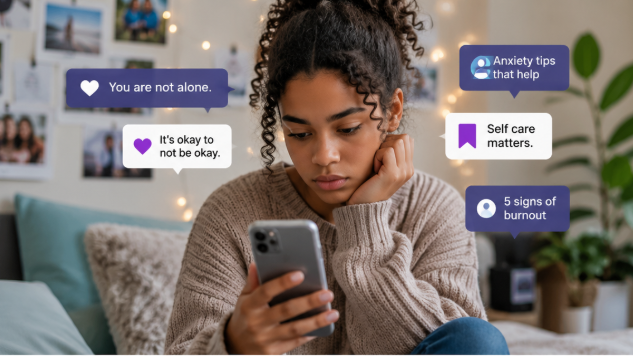
A young person has a question about anxiety, ADHD, depression, trauma, stress, relationships, or something they cannot quite name.
Where do they go first?
Sometimes they ask a parent. Sometimes a friend. Sometimes a counselor or another trusted adult.
And sometimes they open TikTok, YouTube, Instagram, Reddit, or an AI tool and start searching.
That is already part of how many young people learn about mental health. So the answer cannot simply be, "Stop looking online."
The Internet Is Already in the Conversation
A 2025 Pew Research Center survey found that 34% of U.S. teens ages 13 to 17 at least sometimes get mental health information from social media.
Among those teens, 63% said social media is an important source of mental health information for them.
The numbers were higher among Black teens. About 49% of Black teens said they sometimes get mental health information through social media, compared with 35% of Hispanic teens and 30% of White teens.
If young people are already searching, the better question is: How do we help them decide what deserves their trust? Not Everything Online Is Bad Information
There is a reason young people search online.
Sometimes a video gives someone language for an experience they could not explain, or helps them feel less alone.
Social media can also provide real connection.
Pew found that:
- 74% of teens said social media makes them feel more connected to what is happening in their friends' lives.
- 63% said it gives them a place to express their creativity.
- 52% said they have people who will support them through tough times.
That matters. But useful is not the same thing as accurate. A person can be relatable and still be wrong.
Mental Health Does Not Always Fit Into a 45-Second Video
Online content rewards speed and certainty. Mental health is rarely that neat.
A video may say:
- "If you do these five things, you have ADHD."
- "If you hate being around people, that is social anxiety."
- "If your parent does this, they are a narcissist."
- "This one habit means you have trauma."
That can sound convincing when a young person recognizes themselves in it. But symptoms overlap. Stress, sleep problems, grief, family conflict, physical health concerns, and behavioral health conditions can look similar.
Online content may help someone recognize that something deserves attention. It cannot replace an appropriate assessment.
Now There Is Something Answering Back
A video does not respond. A chatbot does.
That is a meaningful difference, and it is newer than most of the guidance families have been given.
A study published in JAMA Pediatrics surveyed 1,009 young people ages 12 to 21 and found that 19.2% had used an AI chatbot for advice or help when feeling sad, angry, nervous, or stressed. Among those who did, nearly 43% did so at least monthly.
The finding most relevant to caregivers is this one:
63% had not told anyone they were doing it.
Not a parent. Not a friend. Not a counselor.
And 92% said the advice was somewhat or very helpful. The researchers offered a caution alongside that number. High satisfaction may reflect a chatbot's tendency to agree with and flatter the user rather than the actual quality of the guidance.
A chatbot can be agreeable and still be wrong. Common Sense Media tested major AI chatbots on mental health scenarios and reported systematic failures to recognize conditions including anxiety, depression, ADHD, eating disorders, mania, and psychosis. Their testing also found that safety guardrails performed less reliably in long, realistic conversations than in single exchanges. That last detail deserves attention. A young person in real distress is not asking one question. They are talking for a while.
What Adults Can Do Without Becoming the Phone Police
1. Ask What They Found. Start with curiosity.
- What did you see that got your attention?
- What part sounded familiar?
- Did the person say where the information came from?
- Did it make you feel better, more worried, or more confused?
You will learn more when honesty does not feel like a setup for punishment.
That applies to AI as well. Given that most young people who use chatbots this way tell no one, a calm question is far more likely to get an answer than a rule.
2. Look at the Source Together. Ask who created the information.
Is it coming from:
- a licensed behavioral health professional;
- a recognized health organization;
- a university or research institution;
- someone sharing a personal experience;
- an account making broad claims without clear sources;
- or a chatbot that has no way to know the young person's history?
Personal stories have value, but they are not professional guidance. Neither is a confident answer from a system built to keep a conversation going.
3. Do Not Turn "This Sounds Like Me" Into an Instant Diagnosis
There is a middle ground. You do not have to confirm a diagnosis, and you do not have to dismiss the concern because it came from social media.
Try: "That sounds like something worth learning more about." Then keep the conversation going.
4. Pay Attention to What the Content Is Doing
Pew found that teens also see downsides to social media.
- 45% said it hurts their sleep.
- 40% said it hurts their productivity.
- 39% said it can leave them overwhelmed by drama.
- 19% said it hurts their mental health.
So look beyond the subject of a post.
Is the young person learning something useful? Or are they becoming more fearful, overwhelmed, isolated, or convinced that every difficult feeling needs a label?
The effect matters too.
5. Give Them Somewhere Else to Go
If we want young people to depend less on random online advice, they need real alternatives:
- a parent or caregiver who can listen;
- a trusted relative, coach, mentor, or teacher;
- a counselor or therapist;
- a case manager;
- a pediatric or primary care provider;
- reputable mental health organizations.
Young people will keep asking questions. We should make sure the internet is not the only place willing to answer them.
The chatbot research makes this point plainly. Nearly two-thirds of young people using AI for emotional support told no one. That is not only a question of what they are being told. It is a question of who else was available.
Where H.Y.P.E. Fits
H.Y.P.E. of Lucas provides community-based behavioral health services for children, teens, and families, including case management, group services, family and individual counseling, diagnostic assessments, and individualized treatment planning.
Sometimes a young person has already searched online, talked to friends, or tried to name what they are feeling before an adult knows there is a concern.
That information can be part of the conversation.
It does not have to be mocked. It also does not have to be accepted without question.
There is room between those two reactions.
The Goal Is Not to Win an Argument With the Internet
Young people have access to more mental health language than generations before them. Some is helpful, some is incomplete, and some is wrong.
Young people need more than warnings about screen time. They need mental health literacy.
They need practice asking:
Who is saying this? What evidence supports it? Does it fit my situation? Who can I talk to offline if I am concerned?
That is a useful National Wellness Month conversation. And unlike an algorithm, it gives young people somewhere real to go next.
Sources
- Pew Research Center: Teens, Social Media and Mental Health
- RAND: Nearly 1 in 5 U.S. Adolescents and Young Adults Use AI Chatbots for Mental Health Advice (published in JAMA Pediatrics)
- Common Sense Media: Major AI Chatbots Unsafe for Teen Mental Health Support
- Child Mind Institute: Safeguarding and Improving Youth Mental Health in the Digital Era
- NAMI: Social Media and Mental Health
- H.Y.P.E. of Lucas Behavioral Health Services